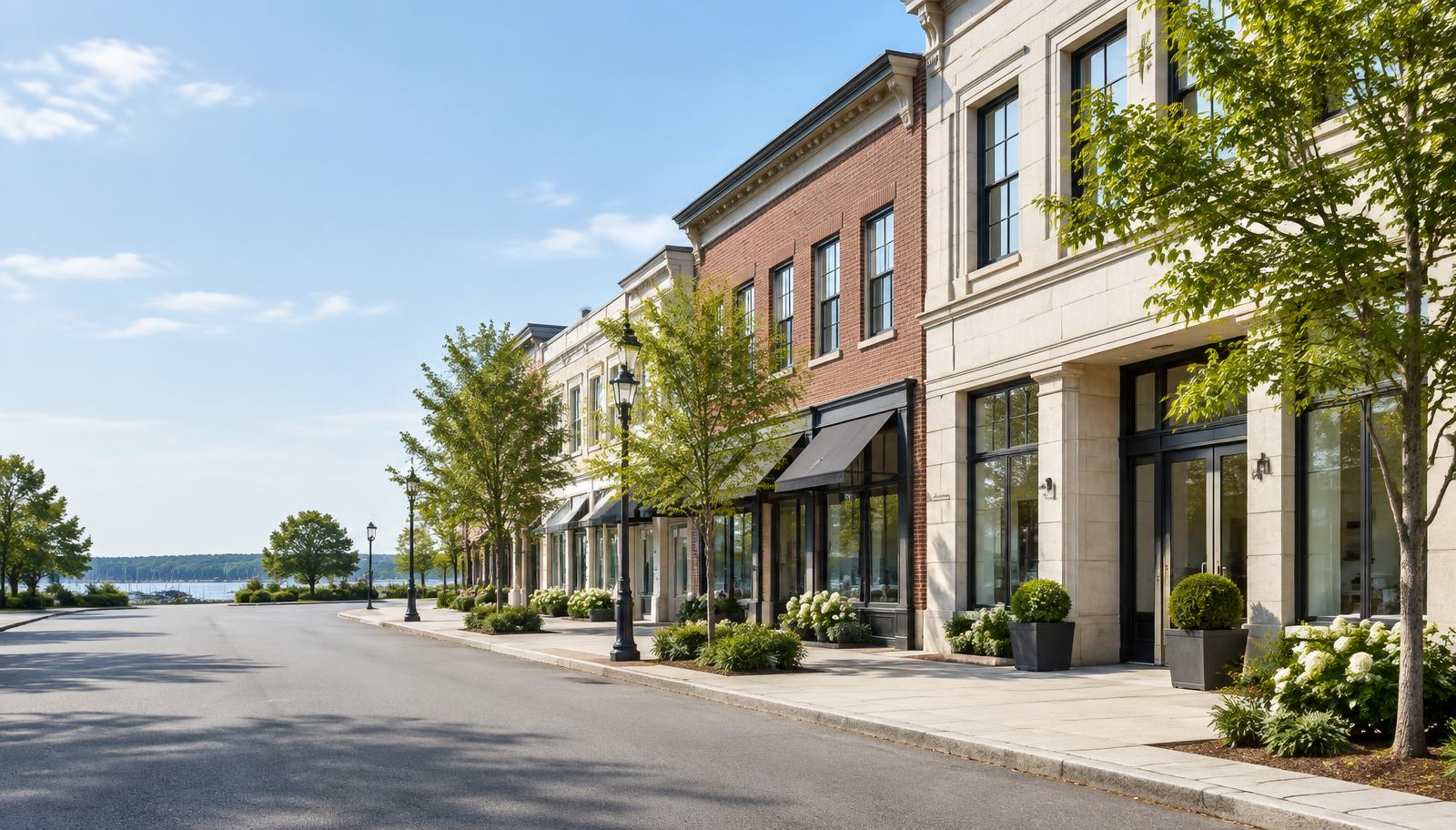
Buying, selling or valuing commercial property in Greenwich? Start with the guides below. They cover taxes, assessment, the 2025 revaluation, zoning and office-market data. The publisher is not licensed in Connecticut. No Connecticut brokerage services are offered.
For owners, start with selling, a broker opinion of value or a 1031 exchange. For buyers, start with the purchase guide and the district that interests you. Keep the report's dates and geographic boundaries in view when comparing office figures.
Use these guides to prepare questions for a Connecticut-licensed broker before signing anything.
Buying or selling
The office market. CBRE Research says Class A space captured 90% of Fairfield County office leasing in Q2 2026. The Q2 2026 market report sets out the quarter's numbers.
Buying a building. Weighing a purchase? Read commercial property for sale in Greenwich for the conveyance tax, land records, assessment and zoning a buyer meets, each with its source.
Selling a building. Thinking about a sale? Read selling commercial property in Greenwich for what to gather first. A common first step is a broker opinion of value. For a non-residential sale, Conn. Gen. Stat. 12-494 (current revision) sets a state conveyance tax of one and one-quarter percent of the consideration, plus a municipal tax of one-fourth of one percent.
Space in the CBD. CBRE Research counted only 236,000 square feet of office space available in the Greenwich CBD in Q2 2026. The Central Greenwich guide covers the zoning and projects on the Avenue.
Value and exchanges
- Broker opinion of value. A market analysis for the owner or the owner's designee under Conn. Gen. Stat. 20-526(2), which says the estimate may not be called an appraisal.
- 1031 exchange. Section 1031 of the Internal Revenue Code gives you 45 days after a sale to identify replacement real property and no more than 180 days to receive it.
Office market snapshot
CBRE Research's Q2 2026 Fairfield County office report, published in July 2026, singles out the Greenwich CBD as "an outlier," citing strong transit access and a high concentration of financial services tenants. Three of its numbers set the tone for the quarter:
- 10.7% availability in Q2 2026. CBRE says negative absorption of 44,000 square feet pushed Greenwich CBD availability up 200 basis points in Q2 2026.
- $126.24 per square foot. CBRE calls this Q2 2026 average asking rent for the Greenwich CBD a record high.
- 45% sublease in Q2 2026. CBRE says sublease supply made up 45% of the CBD's available space in Q2 2026, against 11% countywide.
For scale, CBRE's Q2 2026 Fairfield County figures put countywide office availability at 24.4% and the average asking rent at $36.57 per square foot.
A note on bases. Lincoln Property Company's Q1 2026 Fairfield County office report lists Greenwich at 14.2% vacancy on 4,100,000 square feet of inventory, with a $52.00 average asking rate. That is a different measure (vacancy, not availability), a different area (Greenwich as a submarket, not only the CBD) and a different quarter. Do not set one figure against the other. The full breakdown, with each source and its basis, is in the Greenwich Q2 2026 market report.
Explore Greenwich
- Central Greenwich. The Town's 2019 Plan of Conservation and Development defines Central Greenwich as Greenwich Avenue and Putnam Avenue between Dearfield Drive and Milbank Avenue.
- West Putnam Avenue. The same 2019 plan describes an Office District running from Weaver Street to Columbus Avenue and Oak Street, anchored by the Greenwich Office Park.
- Cos Cob. The Metro-North New Haven Line timetable (September 2026) puts Cos Cob station 30 miles from Grand Central.
- Old Greenwich and Riverside. The Greenwich Free Press reported in October 2025 that the Old Greenwich Village District went into effect on December 4, 2024.
History and local rules
Greenwich Avenue is not an ordinary main street. The National Park Service nomination for the Greenwich Avenue Historic District (listed August 31, 1989) calls it "an exceptionally well-preserved commercial and municipal district which contains uninterrupted, highly cohesive commercial blocks of unusual architectural diversity." The same nomination counts 162 resources in the district, 136 of them contributing, in a district built between 1860 and 1940.
That history shows up in the rules a deal has to work within. The Town's Building Zone Regulations (August 2023 compile) protect the ground floor of the CGBR zone for retail: Use Group 1 uses must fill at least 75% of the largest floor, and banks and financial services are barred from the first floor. The Town also imposes a ninety-day wait before a demolition permit for any building of 500 square feet or larger built before 1940.
National Register listing is not the same as local protection. In a July 2026 letter, First Selectman Fred Camillo wrote that 2 Greenwich Avenue, a contributing structure in the district, has no local protection from demolition because it has no Historic Overlay zone and is not locally designated.
Read how Greenwich became a commercial center for the story behind the Avenue, the railroad and the office era. When you are ready, the contact page lists what to send a Connecticut licensee.
Common questions
- What is the office availability rate in downtown Greenwich, CT?
- CBRE Research put the Greenwich CBD office availability rate at 10.7% in Q2 2026, up 200 basis points in the quarter. CBRE said only 236,000 square feet remained available in what it called a small, in-demand market.
- How much is office rent in Greenwich, CT?
- CBRE Research reported a record-high average asking rent of $126.24 per square foot in the Greenwich CBD in Q2 2026. Lincoln Property Company listed a Greenwich submarket average asking rate of $52.00 per square foot in Q1 2026. The two cover different areas and quarters, so compare each on its own basis.
- Why is so much Greenwich office space offered as sublease?
- CBRE Research said additional sublease space at premium rents drove the rise in Greenwich CBD availability in Q2 2026. Sublease supply made up 45% of the CBD's available space, against 11% countywide.
- What should a commercial broker agreement in Connecticut say?
- Connecticut law says no person may act as a real estate licensee without a license unless exempt, so check the license first. Under Conn. Gen. Stat. 20-325a, a licensee may not bring an action over services rendered unless they were rendered under a written contract or authorization. For a commercial deal, a signed writing can do the job if it states for whom the licensee will act, the duration of the authorization and the amount of any compensation.
- What is the difference between a broker opinion of value and an appraisal in Connecticut?
- Conn. Gen. Stat. 20-526(2) lets a licensed broker estimate value as part of a market analysis for the owner or the owner's designee, for example ahead of a listing or sale. The statute says that estimate may not be called an appraisal or be construed as one. The federal banking agencies' 2010 appraisal and evaluation guidelines also say a broker price opinion cannot be used as an evaluation because it does not provide market value.
- How long does a 1031 exchange allow to buy a replacement property?
- Under section 1031 of the Internal Revenue Code, replacement property must be identified within 45 days after you transfer the property you give up. It must be received by the earlier of 180 days after that transfer or the due date, with extensions, of your tax return for that year. Talk to a qualified intermediary and a tax adviser before you sign a sale contract.
- What are the main commercial areas of Greenwich, CT?
- The Town's 2019 Plan of Conservation and Development lists the Central Greenwich and downtown districts, the Post Road corridor along East and West Putnam Avenue, and villages such as Byram and Old Greenwich. Cos Cob, Riverside and Old Greenwich each have their own Metro-North New Haven Line station.